
When Black Swan came out a couple of years back, there were a number of films whose names were thrown about a lot as the inspiration behind it. One of which was Michael Haneke's The Piano Teacher. I had heard about how intense and crazy it was and after watching Funny Games, I was a bit hesitant to watch this. But it is a film that has completely won me over.


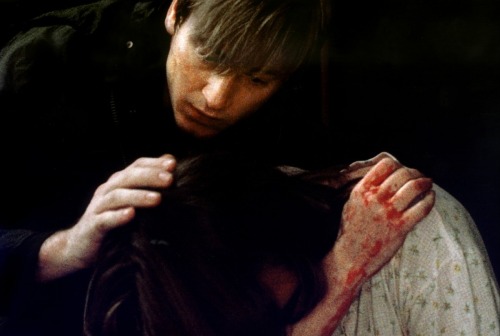
Coming to writing and directing, after watching a film as self-conscious as Funny Games, I did not expect something like The Piano Teacher from Haneke. It is based on a novel of the same name by Elfriede Jelinek. As I wrote above, I thought it was really honest, almost brutally so. He is known to be a daring director, and this was a really undaunted effort. I liked the fact that it doesn't try to shock us, but instead tries to make us feel the intensity of things that Erika goes through. Also he added another layer to it, a student of Erika's whose life practically mirrors her own, and it makes one think about the actions that Erika takes against her are actually for whose harm or benefit. The film made me reflect a lot about what all can the lack of control drive people into doing. Even educated and sophisticated women like Erika can do things one will find savage and immoral. Conversely the power of control in the hands of people like the Mother or Walter towards the end of the film, can also be very reprehensible. It is a fantastic film and the fact that it won Grand Prix at the Cannes along with best actress and actor prizes for Huppert and Magimel is not at all surprising.
This is definitely not a review I could blabber on and on in. It is a difficult and divisive film, one that I admired a lot though I don't know how many people will feel the same way about it. Also it is not for everyone, but if you can look past certain things, it is a sad story about what happens when one is oppressed beyond a limit, and how the repercussions can often be horrific.


Erika Kohut is a piano teacher in her late thirties or early forties who still lives with her overbearing mother. They even sleep on the same bed. So constrained in life, Erika seeks out pleasure in quite unconventional and eyebrow-raising ways, especially for a woman. Her sexual repression seemingly finds an outlet when a handsome young student, Walter Klemmer, starts fancying her. But her desperate desires are too much for anyone to handle, including herself, and soon things get ugly.
The Black Swan connection for this film is that of a professional artist who lives life under immense control only to find herself being driven mad by it. While Black Swan shows this in melodramatic and surreal ways, The Piano Teacher is real and quite despondent. As intense a film as it was, and though there were some scenes in it which made me very uncomfortable, at the end of it all I could feel was extreme sympathy for this miserable woman.
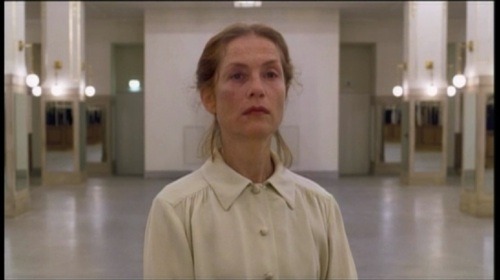
The biggest reason of course why I felt so much for her was the incredible performance by Isabelle Huppert. The whole film is practically driven by just her face. There are entire scenes only focusing on her expressions- they don't seem to change, still they tell everything. It is fascinating. The restraint, the madness, the aloofness, the despair are all apparent on her face, though I wouldn't be able to tell the difference if they were singular shots. For example the scene where Walter tries out for her piano class and plays one of her favourite composers Schubert, the camera is pointed only at her and we can feel how the controlled indifference turns into plain agony for her, as she is so swept away by it. Yet to someone who would have casually glanced at her, they would not have noticed a thing. But on the flipside of it, there are many scenes showing the deviated things she does and in them she is completely emotionless, which scares us and also makes us think what could have possibly impelled someone to do such things.
The other two primary cast members are Benoît Magimel, who plays Walter and Annie Girardot, who plays Erika's mother. Walter at first seems like just another cocky kid who thinks it will be cool to date an older female, but the change in his character due to Erika's ludicrous demands is shocking and makes him unique. Magimel does an excellent job of showing both the lightness and the darkness of his character. Girardot as the Mother has gone on to join my list of mothers-from-hell alongside the likes of Margaret White. Erika has some unspeakable history with her. Her mother constantly rebukes her and both of them keep hurting each other, physically and mentally, but still they stay together, though it's not love that is keeping them together; one cannot help but think it is something sinister instead. Girardot too is very good.
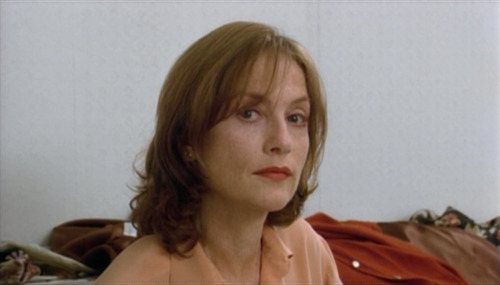
Apart from the cast, the other reason why this film amazed me the way it did was because it felt so authentic. Not in a way that everyone is sexually perverted and has kinky wishes, but that there is a true possibility of someone sitting next to me, who I think is normal, may very well be into questionable stuff. It almost doesn't feel like a film, but a true insight into a very desperate and sick person's life. What made me realise this was one little thing- when Erika starts keeping her hair open after her first tryst with Walter. I mean yes she has a plethora of very serious problems, but it is the most basic of things any woman would do when she wants to be admired. I thought a touch of something like that was truly incredulous. Then there is the way Walter first follows her, trying to be charming, and it made me think that it could have been an absolutely conventional relationship between the two. The truth obviously only comes out behind closed doors, just as it does in people's lives.
The way it is made also helps in this. All the music is actual music being performed in the film. There are no coincidental meetings or circumstances like how they happen in fiction; everything that happens was inevitable as Erika foreshadowed early on, the appearance of Walter just proved to be a catalyst. It is a frightening thought and ultimately what made me feel sorry for, instead of being repulsed by, the truly unfortunate Erika.
This is definitely not a review I could blabber on and on in. It is a difficult and divisive film, one that I admired a lot though I don't know how many people will feel the same way about it. Also it is not for everyone, but if you can look past certain things, it is a sad story about what happens when one is oppressed beyond a limit, and how the repercussions can often be horrific.


